

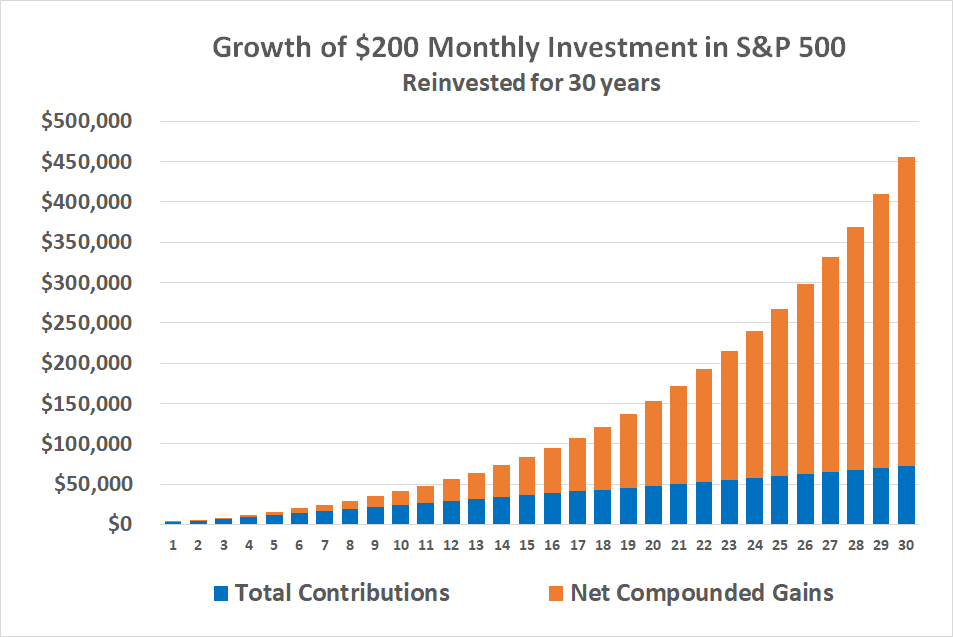
The $200 Wealth Formula: How Low-Cost S&P 500 ETFs Compound Small Sums into $455,000
In an era often dominated by speculative frenzy and high-frequency trading, the most effective path to lasting financial independence remains deceptively simple: disciplined, low-cost index investing. According to recent reporting from The Motley Fool and Yahoo Finance, allocating just $200 per month into a broad-market S&P 500 index ETF can compound into over $455,000 over a multi-decade investment horizon. This long-term analytical deep dive explores how compounding interest, automated dollar-cost averaging, and passive market exposure systematically outperform active stock picking for retail investors seeking effortless wealth accumulation.
The Calculus of Passive Wealth Creation
In the contemporary financial landscape, investors are routinely bombarded with promises of algorithmic shortcuts and hyper-volatile speculative assets. Yet, as highlighted in reports by The Motley Fool and Yahoo Finance, time-tested mathematical fundamentals remain the undisputed champion of retail capital appreciation. The underlying principle is elegant: by committing a modest sum of $200 per month toward a broad-market S&P 500 exchange-traded fund (ETF), an individual can build an investment portfolio valued at approximately $455,865 over a 30-year horizon, assuming historical average annual returns of roughly 10%.
The Mechanics of Compound Interest and Systematic Allocation
Understanding the Power of Exponential Growth
The core engine driving this financial transformation is compound growth—a process wherein accumulated interest generates its own earnings over time. During the initial years, progress appears gradual, almost negligible. However, as the timeline stretches past the two-decade mark, the growth trajectory becomes markedly exponential.
- Minimal Capital Friction: An aggregate contribution of $72,000 spread over 30 years yields more than five times the total invested principal.
- Mitigating Timing Risk: Automated, periodic allocations eliminate the psychological hazards of market timing and emotional decision-making.
- Cost Efficiency: Ultra-low expense ratios in flagship broad-market ETFs ensure that compounding returns are retained by the investor rather than absorbed by management fees.
Dollar-Cost Averaging as a Structural Defense
Market downturns are an inherent element of equity ownership. Dollar-cost averaging (DCA) leverages this volatility by automatically purchasing more ETF shares when valuations dip and fewer when prices peak. This structural mechanism lowers the average cost basis over time, converting short-term market corrections into dynamic engines for long-term outperformance.
Strategic Implications for Modern Asset Allocators
While the S&P 500 offers exposure to five hundred of the largest publicly traded American corporations, maintaining a disciplined asset allocation model requires constant monitoring of macroeconomic indicators and valuation shifts. If you're considering portfolio rebalancing, check the detailed charts and performance trends on the FireMarkets SPY(SPY) page. Also refer to sector analysis on Market Insight.
FireMarkets Intelligent Outlook
Real-time technical analysis and AI sentiment for SPY, IVV, VOO.
View AI Analysis Summary
Firemarkets.net AI Analysis Result:
* Not financial advice. Data for informational purposes only.
Want deeper analysis on this asset?
Check out expert reports and on-chain data provided by FireMarkets specialists.
All content provided by FireMarkets (including news, analysis, and data) is for reference purposes only to assist in investment decisions and does not constitute a recommendation to buy or sell any specific asset.
Financial markets are highly volatile, and past performance is not indicative of future results. Please rely on your own judgment and consult with professionals before making any investment decisions. FireMarkets assumes no legal liability for investment outcomes.